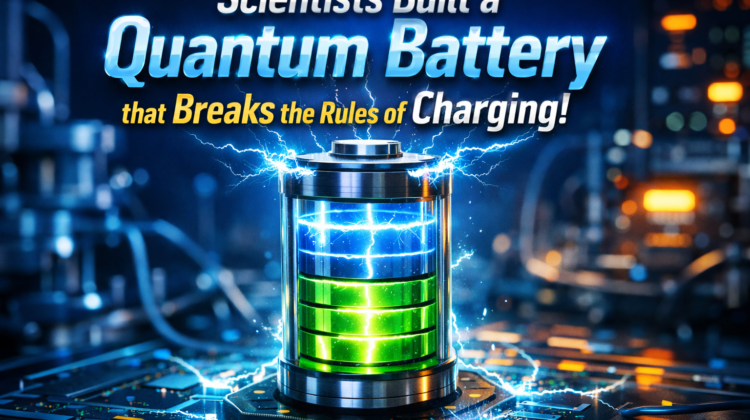
Quantum battery charges in a quadrillionth of a second with a laser — larger prototypes could last for years after charging for just a minute
Imagine charging your smartphone faster than the blink of an eye. Imagine electric cars that need only a few seconds of charging to run for months. Sounds like science fiction, right? But scientists are now exploring a revolutionary technology called the quantum battery, and recent breakthroughs suggest this futuristic dream may one day become reality.
Researchers have successfully demonstrated a tiny quantum battery that can charge in a quadrillionth of a second using laser energy. Even more astonishing, experts believe that larger versions of these batteries could potentially power devices for years after charging for just one minute. This discovery could completely transform the world of electronics, electric vehicles, renewable energy, and even space exploration.
What Is a Quantum Battery?
A quantum battery is not like the lithium-ion batteries used in today’s smartphones or laptops. Instead of storing energy through chemical reactions, quantum batteries use the strange and powerful laws of quantum physics.
Quantum physics governs the behavior of particles at the atomic and subatomic levels. Scientists discovered that particles can interact in ways impossible in classical physics. By using these unique quantum properties, researchers can create energy storage systems that charge and release energy incredibly fast.
In simple words, a quantum battery stores energy using the behavior of quantum particles such as electrons, atoms, or photons.
The Incredible Breakthrough
Recently, scientists developed a tiny experimental quantum battery powered by lasers. The most shocking result was its charging speed. The battery reached full charge in just a femtosecond, which is roughly one quadrillionth of a second.
To understand how fast that is:
- One second = 1,000 milliseconds
- One millisecond = 1,000 microseconds
- One microsecond = 1,000 nanoseconds
- One nanosecond = 1,000 picoseconds
- One picosecond = 1,000 femtoseconds
That means the charging process happens almost instantly at a level the human mind can barely comprehend.
Scientists used laser pulses to excite quantum particles inside the battery. These particles absorbed energy collectively rather than individually, which dramatically increased charging efficiency.
Why Quantum Batteries Are So Special
The most exciting feature of quantum batteries is something called quantum advantage. In traditional batteries, each particle stores energy separately. But in quantum batteries, particles can work together simultaneously through a phenomenon known as entanglement.
This cooperation allows the battery to charge much faster than conventional technologies.
Key Advantages of Quantum Batteries
1. Ultra-Fast Charging
The biggest attraction is lightning-fast charging. Future quantum batteries may fully charge devices in seconds or less.
Imagine:
- Phones charging instantly
- Electric vehicles charging while you stop for coffee
- Emergency power systems recharging immediately
2. Long Energy Retention
Scientists believe future prototypes may hold energy for years with minimal loss. That means fewer charging cycles and longer-lasting devices.
3. Higher Efficiency
Quantum systems could reduce energy waste significantly. Traditional batteries lose energy through heat and chemical degradation, but quantum batteries may avoid many of these limitations.
4. Smaller and More Powerful
Quantum batteries could store huge amounts of energy in very compact spaces, leading to thinner smartphones, lighter electric vehicles, and more efficient wearable technology.
How Laser Charging Works
The recent experiment used laser light to transfer energy into a quantum system. Lasers are ideal because they can deliver highly focused, precise energy pulses.
When the laser interacts with the quantum particles:
- The particles absorb energy simultaneously
- Quantum coherence allows coordinated energy storage
- The battery reaches maximum charge almost instantly
This process is radically different from plugging a phone into a wall charger and waiting an hour for chemical reactions to complete.
Could Phones Really Charge Instantly?
In theory, yes. If researchers can scale the technology successfully, future smartphones may charge in less than a second.
However, there are still many engineering challenges:
- Maintaining quantum stability
- Preventing energy leakage
- Operating at room temperature
- Scaling from microscopic systems to commercial products
Current quantum batteries exist only in laboratory conditions and are extremely small. But the progress is encouraging scientists worldwide.
The Impact on Electric Vehicles
Electric vehicles could become one of the biggest beneficiaries of quantum battery technology.
Today’s EVs require:
- Large battery packs
- Long charging times
- Expensive cooling systems
Quantum batteries could solve many of these issues.
Imagine driving an electric car that:
- Charges in under a minute
- Travels for thousands of kilometers
- Maintains battery health for decades
This could accelerate the global transition away from fossil fuels and make electric transportation more practical for everyone.
Revolutionizing Renewable Energy
Renewable energy sources like solar and wind are excellent but inconsistent. Energy storage remains one of the biggest problems in the clean energy sector.
Quantum batteries could:
- Store massive amounts of solar energy
- Deliver power instantly when needed
- Improve grid stability
- Reduce reliance on traditional power plants
A home equipped with solar panels and quantum batteries could potentially store enough power for months with exceptional efficiency.
Applications Beyond Earth
Space agencies are also interested in quantum battery technology. Space missions require lightweight, long-lasting, and highly reliable power systems.
Quantum batteries may one day power:
- Satellites
- Space stations
- Mars rovers
- Deep-space probes
Since they could retain energy for extremely long periods, they are ideal for missions where replacing batteries is impossible.
Challenges Scientists Still Face
Although the progress is groundbreaking, quantum batteries are far from commercial reality.
Major Obstacles Include:
1. Scalability
Current prototypes are extremely tiny. Building large-scale quantum batteries remains a huge challenge.
2. Quantum Stability
Quantum states are fragile and easily disturbed by temperature, vibrations, and environmental interference.
3. Cost
Developing and manufacturing quantum systems is currently very expensive.
4. Safety and Reliability
Scientists must ensure these batteries can operate safely in everyday devices.
Despite these obstacles, researchers remain optimistic because quantum computing and quantum communication technologies are advancing rapidly as well.
The Quantum Revolution Is Beginning
The idea of charging a battery in a quadrillionth of a second once sounded impossible. Yet science continues to push the boundaries of human imagination.
Just as smartphones replaced landlines and electric vehicles are replacing gasoline cars, quantum batteries could become the next giant leap in technology.
If successfully commercialized, they may transform:
- Consumer electronics
- Transportation
- Renewable energy
- Medical devices
- Artificial intelligence systems
- Aerospace engineering
The world may soon enter an era where waiting for batteries to charge becomes a thing of the past.
Final Thoughts
Quantum batteries represent one of the most exciting scientific breakthroughs of the modern age. The ability to charge nearly instantly using laser technology could redefine how humans use energy forever.
While the technology is still in its early stages, the potential is enormous. Researchers are uncovering new possibilities every year, and many experts believe quantum batteries could become commercially viable within the coming decades.
A future where your phone charges instantly, your car runs for years, and clean energy becomes more efficient than ever may no longer be just a fantasy. Thanks to quantum physics, that