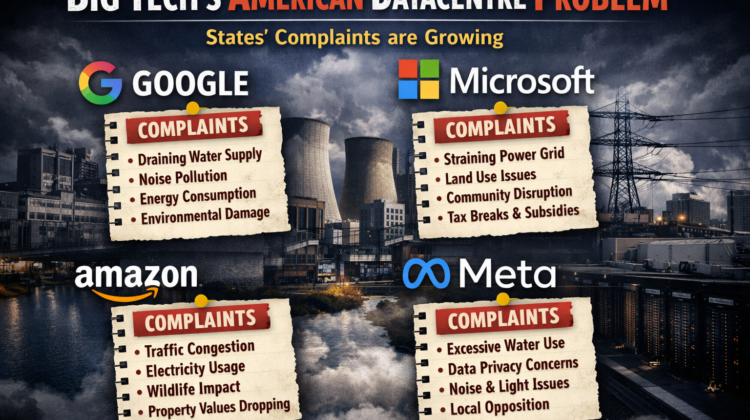
Google, Microsoft, Amazon and Meta have a ‘American datacentre problem’ as the number of States opposing them grows; here’s ‘complaint list’
The rapid expansion of artificial intelligence (AI) has triggered an unprecedented demand for data centres across the United States. Tech giants like Google, Microsoft, Amazon, and Meta are investing billions of dollars into building massive server farms to power AI models, cloud computing, and digital services. However, what was once considered a symbol of economic growth is now turning into a major political and environmental controversy.
A growing number of U.S. states are pushing back against these projects, creating what experts are calling an “American data centre problem.” From environmental concerns to rising electricity costs, the opposition is intensifying—and it could reshape the future of AI infrastructure.
Why Data Centres Are Becoming Controversial
Data centres are the backbone of modern digital infrastructure. They store, process, and distribute massive amounts of data required for AI, cloud computing, and internet services. But these facilities come with significant costs.
According to recent reports, at least 11 U.S. states have proposed laws or restrictions on new data centre construction since late 2025. This marks a dramatic shift from earlier years when states actively competed to attract such investments.
The core issue is simple: data centres consume enormous amounts of electricity and water, placing pressure on local resources. As AI demand surges, these requirements are only increasing.
The Key Complaints Against Big Tech Data Centres
1. Massive Power Consumption
One of the biggest concerns is energy usage. Data centres require huge amounts of electricity to run servers and cooling systems. This has led to fears that local power grids could become overloaded.
In fact, many planned projects are already facing delays due to shortages of electrical infrastructure like transformers and batteries.
Local communities worry that this demand could lead to higher electricity bills for residents. This concern has even reached the White House, where tech companies were asked to bear energy costs themselves.
2. Water Usage and Environmental Impact
Cooling systems in data centres consume vast quantities of water. In regions already facing water scarcity, this has become a major issue.
Environmental groups argue that these facilities can harm ecosystems and increase carbon emissions, especially when powered by fossil fuels. Opposition is often strongest in rural or environmentally sensitive areas.
According to research, community resistance is largely driven by concerns such as water consumption, noise pollution, and land use.
3. Limited Local Benefits
While tech companies promise jobs and economic growth, critics argue that the benefits are often overstated. Data centres are highly automated and do not create large numbers of long-term jobs.
At the same time, local communities bear the burden of increased infrastructure stress and environmental costs. This imbalance has fueled the perception that tech giants are profiting at the expense of local residents.
4. Rising Political and Public Backlash
Opposition to data centres is no longer limited to activists—it has become a bipartisan political issue in the U.S.
Both Republican and Democratic leaders have raised concerns, though their reasons differ. Republicans often criticize tax incentives and grid strain, while Democrats focus on environmental impact.
This rare bipartisan alignment shows how serious the issue has become. In some areas, local elections have even been influenced by data centre debates.
States Leading the Opposition
One of the most striking developments is the move by certain states to directly block or restrict data centre projects.
- Maine is expected to become the first state to impose a formal ban or moratorium on new data centres.
- Several other states are considering similar legislation or tightening regulations.
- Local governments across the Midwest and Northeast are also resisting new projects.
This trend suggests that resistance is not isolated but spreading nationwide.
AI Boom vs Infrastructure Reality
The rise of AI is the primary driver behind the surge in data centre construction. Companies are investing over $650 billion into infrastructure to stay competitive in the AI race.
However, the reality on the ground tells a different story:
- Nearly half of planned data centre projects in the U.S. could be delayed or cancelled
- Power infrastructure shortages are slowing expansion
- Supply chain issues are affecting critical equipment
This mismatch between ambition and execution highlights the scale of the problem.
The “NIMBY” Effect: Not In My Backyard
A key factor behind the backlash is the classic “NIMBY” (Not In My Backyard) phenomenon.
While most people support technological growth in general, they oppose projects being built near their homes. Data centres, once seen as invisible infrastructure, are now highly visible and controversial.
Communities are organizing protests, lobbying politicians, and demanding stricter regulations. Over 140 activist groups across multiple states are actively opposing data centre developments.
Big Tech’s Response to the Crisis
To address these concerns, companies like Google, Amazon, Microsoft, and Meta have started taking action:
- Promising to pay for their own power infrastructure
- Investing in renewable energy projects
- Engaging more with local communities
- Improving transparency around environmental impact
For example, tech companies recently pledged to cover electricity costs to prevent burdening consumers.
However, critics argue that these measures are not enough and lack enforcement.
The Bigger Picture: A Turning Point for AI Growth
The data centre controversy reflects a broader tension between rapid technological advancement and societal impact.
On one hand, AI promises innovation, economic growth, and global competitiveness. On the other, it raises serious questions about sustainability, resource allocation, and fairness.
Experts warn that if these issues are not addressed, the U.S. could face significant challenges in maintaining its leadership in AI.
What Happens Next?
The “American data centre problem” is likely to shape the future of the tech industry in several ways:
- Stricter regulations on data centre construction
- Increased focus on energy-efficient